
Transforming Siemens Data into Action - Agentic AI on Siemens Xcelerator Ecosystem
Siemens provides the measurement, control, and operational technology foundation under its Siemens Xcelerator Ecosystem. From SIMATIC controllers and TIA Portal engineering to Teamcenter product lifecycle management, Opcenter manufacturing execution, NX and Simcenter design and simulation, Insights Hub industrial telemetry, Building X smart infrastructure operations, and Railigent X asset performance management, the Siemens Xcelerator Ecosystem generates a vast amount of operational data and institutional knowledge every day.
INTUMIT adds the intelligence layer above it. Through the Agentic AI Admin Portal, controller alarms, engineering documentation, machine manuals, SOPs, maintenance records, and operational data become a governed, multilingual, conversational experience. Instead of searching across multiple systems, users interact with AI agents that retrieve the right information, reason across connected data sources, recommend next actions, draft work orders and reports, and maintain a complete audit trail of every interaction.

The result is a practical AI layer that bridges people, knowledge, and industrial systems, helping organizations reduce response times, improve decision-making, preserve expertise, and streamline operations without replacing existing Siemens investments.
We work alongside Siemens Solution Partners, industrial system integrators, machine builders, panel builders, distributors, manufacturing operators, facility managers, utilities, and rail operators to deliver AI copilots and industrial agents tailored to real operational workflows.
What INTUMIT and Siemens Each Bring
INTUMIT: AI and Orchestration Layer
Siemens: Industrial Foundation
- Agent orchestration, multi-step reasoning, and enterprise AI workflows using technologies such as Multi-Intent Routing, MCP, and Agent-to-Agent (A2A) communication
- Multichannel user experiences across voice, HMI, mobile, web, Microsoft Teams, LINE, and other enterprise channels
- Multilingual conversational AI, including natural language understanding (NLU) and text-to-speech (TTS) across multiple languages
- Governed RAG (Retrieval-Augmented Generation) over equipment manuals, SOPs, maintenance records, engineering change orders, incident reports, and operational knowledge
- Integration with ERP, CMMS, QMS, ticketing, workflow, and approval systems
- Local deployment, onboarding, customization, training, and in-country support services
- Official APIs, data connectivity, and platform access across Siemens solutions including Insights Hub, Teamcenter, Opcenter, and related Xcelerator products
- Industrial Edge infrastructure and certified deployment pathways for industrial environments
- The underlying automation, operational technology, and infrastructure systems already running in customer environments
- Equipment documentation, asset information, article-number catalogs, and spare-parts data sources
- Joint go-to-market opportunities, customer engagement, and solution positioning through the Siemens Xcelerator Ecosystem and partner network
- Product roadmap alignment, platform expertise, and technical support under established service agreements

Agents on the Digital Twin
Siemens defines a digital twin as a virtual representation of a real-world asset or system, continuously synchronized with sensor and IoT data. It is inherently bi-directional: insight from the twin informs actions in the physical world, while physical-world events continuously update the twin. Siemens’ vision is clear. AI-powered digital twins combine physics-based simulation with real-time operational data to create dynamic, evolving representations of products, machines, and entire production systems, progressing from analysis and prediction toward closed-loop optimization and, ultimately, autonomous operations.
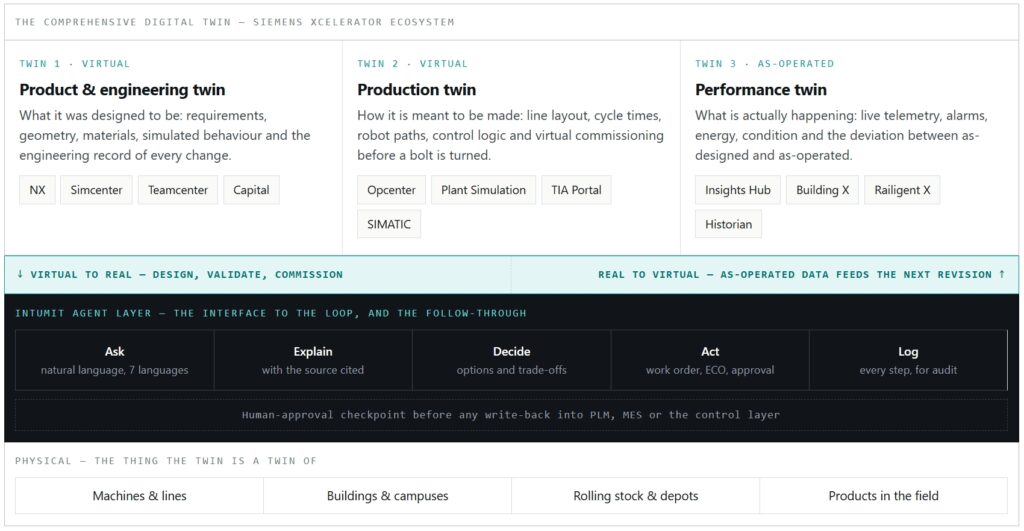
That is the layer Siemens builds.
The gap we still encounter in most industrial environments is what happens after the insight is generated. A digital twin can answer “What is happening?” and “What if?” It rarely answers “So what?”, “Who needs to act?”, “What procedure should they follow?”, or “How do we communicate that in a way every operator understands?”
The people who need those answers most are often the least likely to interact directly with a simulation platform: the technician standing at the panel, the maintenance contractor arriving onsite, the shift supervisor conducting handover, or the facility operator responding to an alarm.
This is where the agent layer sits.
INTUMIT’s Agentic AI Admin Portal acts as the conversational interface and execution layer above the digital twin. AI agents translate insights into actions, retrieve the relevant procedures and documentation, coordinate workflows across systems, draft work orders, guide personnel in their preferred language, and maintain a complete audit trail from signal to decision to execution.
The digital twin explains what could happen. The agent layer helps people decide what to do next and ensures it gets done.
What an Agent Does on a Digital Twin
Twin Interrogation in Plain Language – From complex models to immediate answers
Engineers, operators, and supervisors ask questions in natural language instead of navigating multiple systems. The agent retrieves operational data from the performance twin, engineering intent from the design twin, and presents a source-backed explanation in seconds.
As-Operated vs. As-Designed Deviation Detection – Continuous comparison between reality and design intent
The agent continuously compares real-world operating conditions against engineering models and design specifications. When deviations emerge, it identifies the gap, estimates the potential impact, and prepares the documentation needed for engineering review and corrective action.
Simulation Result Explainer – Turning complex studies into decisions people can use
Simulation outputs are translated into clear operational guidance. The agent explains the findings, assumptions, risks, and recommendations in language appropriate for production teams, maintenance personnel, management, and contractors.
Scenario Request Broker – Self-service digital twin simulation
Instead of waiting for simulation specialists, users simply ask operational “what-if” questions. The agent gathers the required inputs, launches the appropriate analysis workflow, and returns the results together with recommended actions and supporting rationale.
Twin-Grounded Field Guidance – Operational intelligence at the point of work
While standing at the asset, technicians can ask for the current condition, operating limits, maintenance history, relevant procedures, and known issues. The agent combines live twin data with documentation and historical records to guide field execution safely and consistently.
Commissioning & Handover Copilot – Connecting project delivery with operations
The agent consolidates commissioning records, virtual commissioning outputs, as-built documentation, testing results, punch-list items, and handover packages into a single searchable knowledge source, ensuring operations teams inherit complete and accurate information from day one.
Business Outcome
1. Line-Side Fault Triage & Work Order Automation
What it does
When a SIMATIC PLC alarm, machine fault, or Insights Hub alert occurs, the AI agent immediately assists operators and technicians by identifying the likely issue, retrieving relevant troubleshooting procedures, and preparing the next maintenance action.
How it works
The agent correlates alarm data with manuals, SOPs, and historical maintenance records, recommends corrective actions, and automatically drafts a CMMS work order. Operators can interact entirely by voice at the production line, reducing response time and minimizing downtime.
Users
Plant Maintenance, Production Operations
2. Technical Manual & Spare-Parts Copilot
What it does
An AI assistant that allows maintenance personnel, service engineers, and distributors to search Siemens documentation using natural language instead of manually navigating technical manuals and catalogs.
How it works
The agent retrieves information from manuals, wiring diagrams, article-number databases, and spare-parts catalogs, returning source-cited answers and helping users quickly identify compatible parts, specifications, and replacement components.
Users
Maintenance Teams, Service Contractors, Distributors
3. Engineering Change & PLM Copilot
What it does
A Teamcenter-connected engineering assistant that simplifies access to change orders, BOMs, specifications, and product documentation while helping teams assess the impact of proposed changes.
How it works
Engineers ask questions in natural language, and the agent retrieves the relevant records, summarizes engineering changes, identifies affected components and stakeholders, and routes approval workflows to the appropriate reviewers.
Users
Engineering Teams, PLM/CAD Teams, Quality Assurance
4. Building & Facility Operations Desk
What it does
An AI operations desk that supports facility and property management teams by turning Building X and Desigo CC data into actionable insights and service responses.
How it works
The agent monitors alarms, service requests, access-control events, and operational data, helping staff prioritize incidents, answer occupant inquiries, coordinate maintenance activities, and improve building performance across multiple channels.
Users
Facility Management, Campus Operators, Building Operations Teams
5. After-Sales Service & Channel Copilot
What it does
A multilingual service assistant that supports OEMs, machine builders, panel builders, distributors, and service teams with faster access to product, configuration, and support information.
How it works
The agent answers questions related to compatibility, commissioning, configuration, lead times, warranty policies, and RMAs while integrating with existing support processes. Routine inquiries are automated, allowing technical teams to focus on higher-value cases.
Users
After-Sales Service, Channel Partners, Machine Builders
6. Production Knowledge & Shift Handover Copilot
What it does
A multilingual AI assistant that captures shift handovers, production events, downtime reasons, and operator notes, turning daily operational activity into searchable knowledge. Quickly understand what happened on a line, what remains unresolved, and what actions should be taken next.
How it works
The agent continuously ingests shift logs, operator notes, MES data, downtime records, and production events, automatically generating handover summaries, highlighting unresolved issues, and linking relevant SOPs, maintenance history, and past incidents. Ask questions in natural language and receive source-backed answers, operational context, and recommended next steps.
Users
Production Operations, Shift Supervisors, Plant Managers, Continuous Improvement Teams
Customer's Benefit
Faster fault resolution and reduced downtime – The right procedure, troubleshooting guide, and historical fix recommendations reach technicians within seconds, helping reduce mean time to repair (MTTR).
Institutional knowledge brought back to life – Decades of manuals, engineering drawings, maintenance records, and case history become instantly searchable and actionable through natural-language conversations.
Multilingual workforce support – Consistent guidance can be delivered across multiple languages, helping global operations, contractors, and frontline teams work from the same source of truth.
Secure deployment aligned with industrial environments – Sensitive operational and engineering data remains within the customer’s approved OT and enterprise boundaries.
Trusted, auditable answers – Every response is grounded in approved documentation, complete with source citations, traceability, and audit logging.
Works with existing systems, not against them – Integrates with current ERP, CMMS, ticketing, and notification workflows, allowing organizations to enhance existing investments rather than replace them.